Whitepaper · Data platforms
Couchbase as the AI Data Plane for Banking and Telecom
Why the operational database should become the AI data plane for banks and telecom operators. Covers Couchbase capabilities, a reference architecture, twelve banking and telecom use cases, GCC regulatory alignment and a phased roadmap.
Published 7 min read
Banks and telecom operators do not lack AI models. What holds them back is getting the right customer, network and transaction data to those models in milliseconds, under strict regulation. This paper argues that the operational database should become the AI data plane: the single layer that serves live context, vectors, features and agent memory to every AI workload.
Couchbase fits this role because one distributed platform combines operational speed (a memory-first key-value and JSON engine with single-digit millisecond reads), AI-native retrieval (vector search alongside SQL++, full-text and geospatial search), real-time analytics, edge and mobile sync, and sovereign deployment options with cross-region replication (XDCR) for data-residency rules.
The paper is for CIOs, CDOs, enterprise architects and AI platform leads in regulated industries, with a focus on the GCC.
Document
Cannot see the document? Open it in a new tab
The AI data plane: why data, not the model, is the bottleneck
An AI data plane is the runtime layer that feeds live, governed context to models and agents at the moment of decision. It sits between systems of record (core banking, BSS/OSS, network inventory) and the AI layer (LLMs, ML models, agents).
Foundation models are now a commodity. The advantage comes from what surrounds the model: the customer's last ten transactions, the cell site's current alarms, the product terms that apply today, and what the agent already said in this conversation. Three trends make this urgent:
- From batch to real time. Fraud, network assurance and customer care all need decisions in under 100 ms, while analytics platforms still refresh in hours.
- From prediction to generation and agency. RAG and agents need vector retrieval, conversational memory and tool state, not just a feature table.
- From central cloud to edge and sovereign. GCC regulators require in-country data residency, and telecom AI increasingly runs at the network edge.
Most first-generation GenAI projects bolt together a cache, an operational database, a separate vector database, a search engine and a feature store. Every extra copy adds sync lag, a new security perimeter and another audit scope. A converged data plane reduces this to one platform with one security model.
Couchbase capabilities for the AI data plane
Couchbase is a distributed, memory-first JSON database whose services scale independently. Version 8.0, generally available since 21 October 2025, added billion-scale vector indexing and native encryption at rest.
- Operational core: key-value and JSON with sub-millisecond to single-digit-millisecond reads and multi-document ACID transactions.
- SQL++: SQL for JSON, with joins, window functions and global secondary indexes.
- Vector search, three ways: Hyperscale Vector Index for billion-scale collections, Composite Vector Index for filtered search, and Search Vector Index for hybrid semantic and keyword queries.
- Capella AI Services: Model Service, Data Processing, Agent Catalog, Agent Memory, AI Functions and an MCP Server next to the data.
- Eventing and Analytics: server-side functions that re-embed or recompute features on change, and a columnar engine for aggregates.
- Mobile and edge: Couchbase Lite with on-device vector search, synced through App Services or Sync Gateway.
- Resilience and security: XDCR, rack and zone awareness, RBAC, TLS, encryption at rest with KMS/KMIP and auditing.
Reference architecture
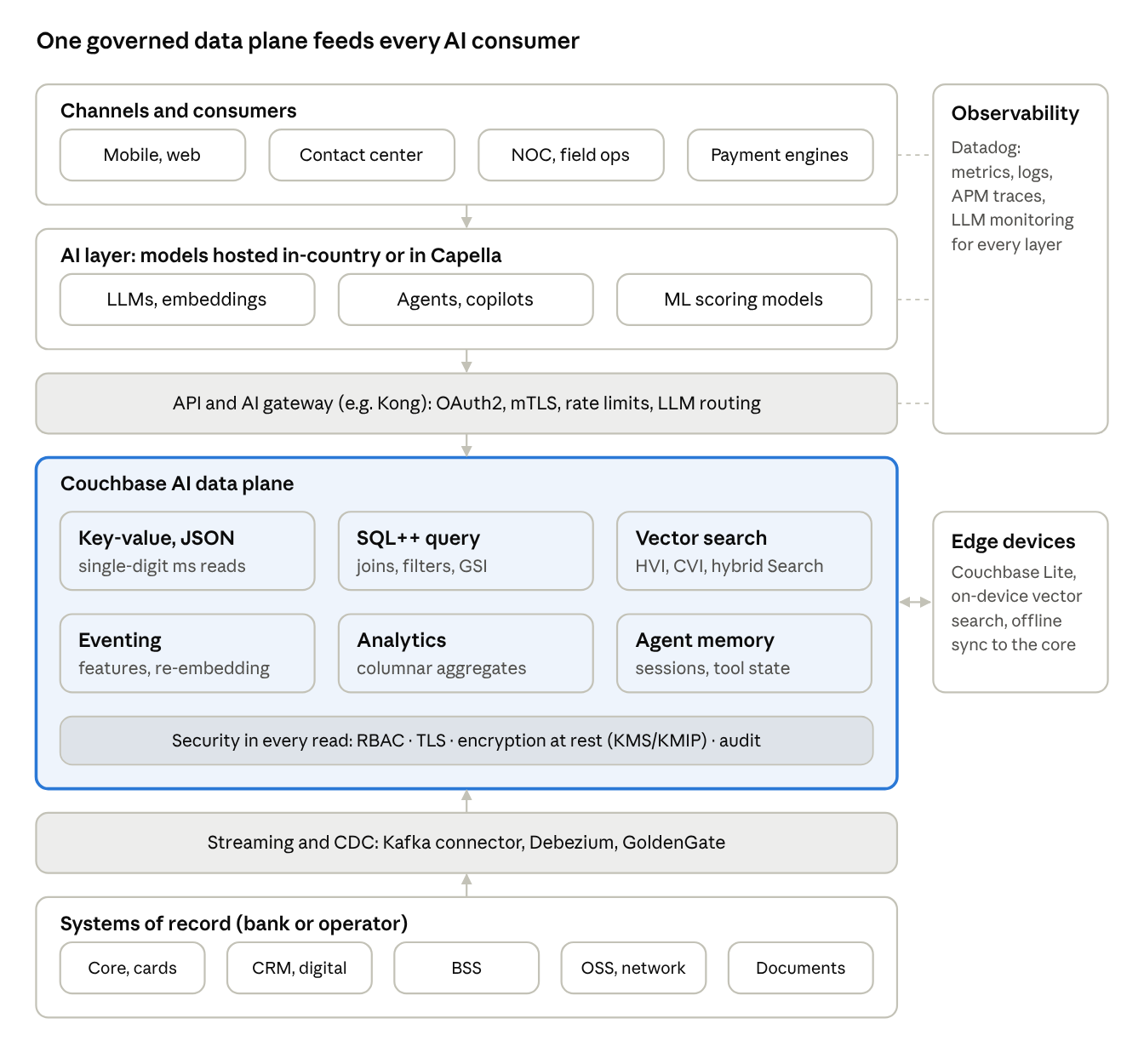
Every AI consumer reaches data through one gateway and one governed Couchbase layer, fed in real time from the systems of record.
Read the figure from the bottom up. Kafka and CDC stream changes from core, BSS and OSS systems into Couchbase within seconds; Eventing keeps features and embeddings current. Models, agents and scoring services call Couchbase through the gateway for context, vectors and memory, and every read passes RBAC, encryption and audit. Edge sites sync a scoped copy both ways, and Datadog observes each layer end to end.
Banking use cases
Each use case below is described in the full paper with the problem, how the data plane serves it and the Couchbase features involved. Target values are typical design goals to confirm in a proof of concept.
- Real-time fraud and mule-account detection: profile reads under 5 ms and a full scoring path within the authorisation budget, with fresh features from Kafka and Eventing.
- GenAI assistant for customer service and relationship managers: grounded answers that combine the customer profile with hybrid search over product terms and circulars.
- KYC, AML and sanctions investigation copilot: evidence gathered across collections, similar past cases found by vector search, and every tool call logged.
- Hyper-personalised offers and next-best-action: offers retrieved by filtered vector search while the customer is still in the app.
- Credit decisioning and early-warning signals: one JSON application document, explainable reason codes and intraday early-warning queries.
- Branch, ATM and field-sales edge: Couchbase Lite on tablets answers product questions offline and syncs when connectivity returns.
Telecom use cases
The same pattern applies: live context by key, hybrid retrieval, event-driven freshness and governed access.
- NOC and network-operations copilot: runbooks, vendor manuals and resolved tickets in a Hyperscale Vector Index, joined with live topology and alarms.
- AI-driven customer care and digital assistant: a Subscriber 360 that combines BSS billing with OSS cell health to explain why data is slow and how it gets fixed.
- Churn prediction and in-session next-best-action: churn features updated as events arrive and retention offers scored the moment the customer opens the app.
- Real-time subscriber context for policy, charging and offers: sub-10 ms reads at busy-hour scale.
- Edge AI at MEC, enterprise 5G and field operations: Couchbase Lite or a small edge cluster that keeps working when backhaul drops.
- Fraud and revenue assurance: SIM-swap, IRSF and Wangiri patterns found by behaviour embeddings, with SIM-swap signals shared with partner banks.
Security, governance and regulatory alignment
Keeping vectors, context and agent memory inside the same governed platform as operational data shrinks the compliance surface. No database makes an institution compliant by itself, but the platform controls support PDPL and SDAIA AI guidance, NCA ECC and CCC, SAMA cyber security and outsourcing rules, CST regulations, UAE PDPL and central bank rules, PCI DSS v4.0, and DORA and the EU AI Act for groups with EU operations.
Governance patterns for AI on Couchbase:
- Scope data per AI use case with dedicated scopes, collections and service accounts.
- Mask or tokenise national IDs, IBANs, card numbers and MSISDNs before embedding.
- Filter retrieval by entitlement so an agent never returns a document the caller may not see.
- Keep embedding and LLM models in-country, and log every AI decision with its sources and model version.
- Govern agent tools in Agent Catalog and require human approval for actions that move money or change the network.
This summary is not legal advice; confirm obligations with your compliance and legal teams.
Implementation roadmap
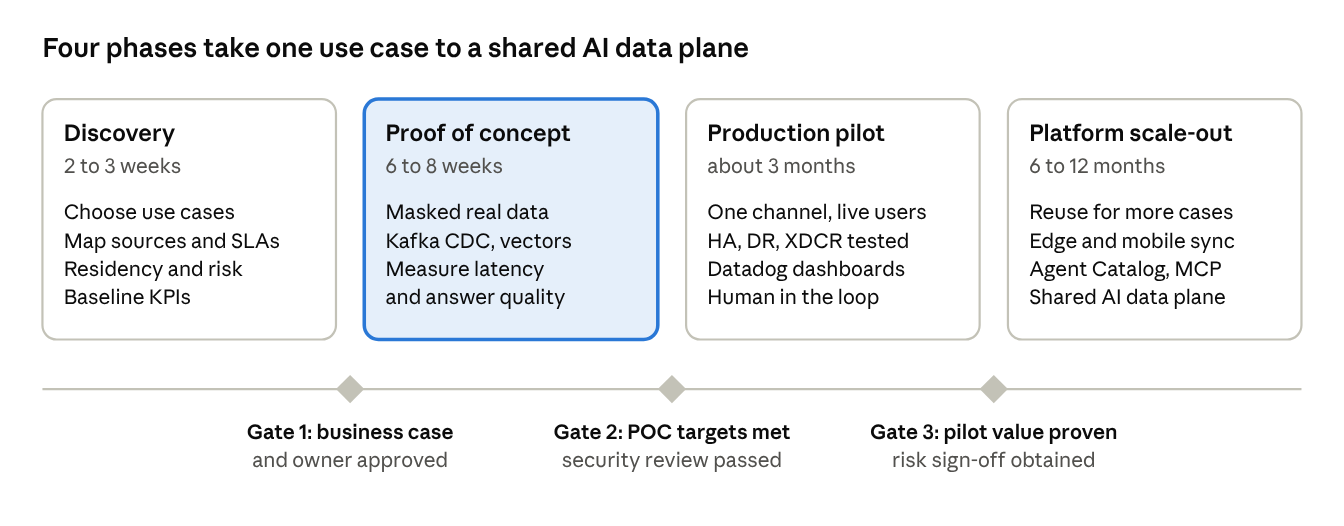
Start with one measurable use case, prove it on real data, then turn it into a shared platform that later use cases reuse.
- Discovery (2 to 3 weeks): choose use cases, map sources and SLAs, settle residency and risk, baseline KPIs.
- Proof of concept (6 to 8 weeks): masked real data, Kafka CDC and vectors, measured latency and answer quality.
- Production pilot (about 3 months): one channel with live users, HA, DR and XDCR tested, Datadog dashboards and a human in the loop.
- Platform scale-out (6 to 12 months): reuse for more use cases, edge and mobile sync, Agent Catalog and MCP, one shared AI data plane.
Success metrics are agreed at Gate 1: latency, retrieval quality, business outcome, freshness, resilience, governance and cost.
Next steps
- Pick one high-value use case per business line (for example fraud scoring or a NOC copilot) with a named business owner.
- Run a two-day discovery workshop to map sources, latency targets, residency constraints and success metrics.
- Build a 6 to 8 week proof of concept on real, masked data, measuring latency, recall and answer quality against the current process.
- Agree the target topology (self-managed, Kubernetes or Capella) with security, risk and the regulator-facing team.
- Plan the step from pilot to platform so the second and third use cases reuse the same data plane.
A question about this?
Tell us what you are evaluating and we reply with what fits.
More resources
- WhitepaperData platforms Architectural Strategies for Resilient, Storage-Aware CDC Pipelines Why Change Data Capture pipelines fail when storage fills up, and how an intelligent control plane prevents it. Covers proactive backpressure, automated storage recovery, adaptive snapshots, idempotent delivery, schema-change protection and a capacity-planning formula. Read the whitepaper
- WhitepaperSystem integration Interkey Professional Services for Kong How Interkey delivers Kong Gateway, AI Gateway, Kong Mesh and Insomnia as one governed connectivity platform. Covers the reference architecture, service catalog, four-milestone delivery, prerequisites, success metrics and GCC regulatory alignment. Read the whitepaper
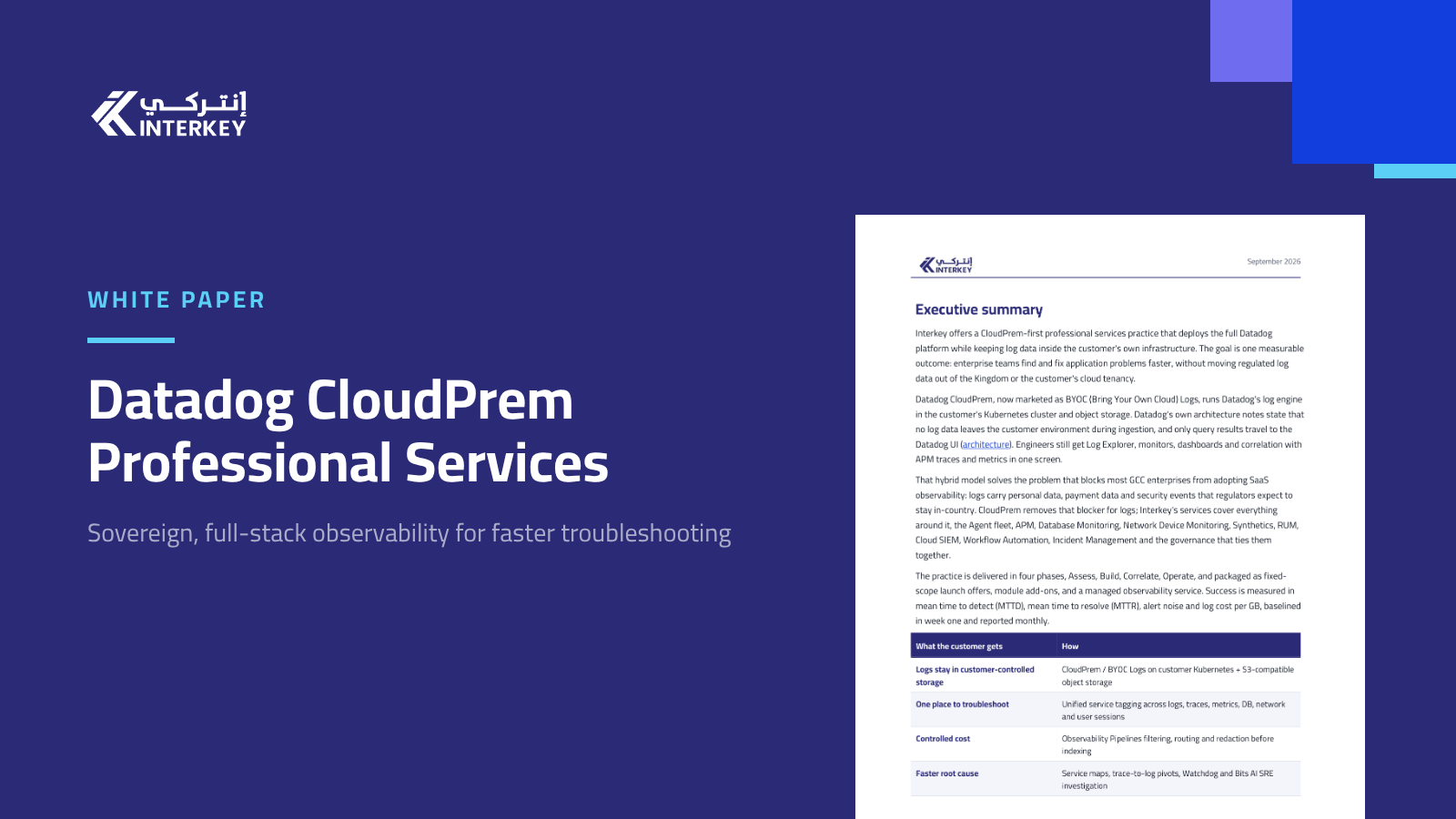
- WhitepaperObservability Datadog CloudPrem Professional Services How Interkey deploys the full Datadog platform with CloudPrem so log data stays inside your own infrastructure. Covers the reference architecture, sizing, HA/DR, a troubleshooting walkthrough, the service catalog, delivery phases and KSA regulatory alignment. Read the whitepaper
Next step
Need something the library does not cover yet?
Tell us what you are evaluating, and an engineer from the Riyadh team replies with what exists, in Arabic or English.
Or directly
+966-11-2180999 [email protected]Tawuniya Towers, North Tower, 7th Floor, King Fahad Highway, Olaya, P.O. Box 56835, Riyadh 11564, Saudi Arabia