Whitepaper · System integration
Interkey Professional Services for Kong
How Interkey delivers Kong Gateway, AI Gateway, Kong Mesh and Insomnia as one governed connectivity platform. Covers the reference architecture, service catalog, four-milestone delivery, prerequisites, success metrics and GCC regulatory alignment.
Published 5 min read
Interkey delivers Kong as a governed, production-grade connectivity platform in four milestones: Discovery, POC, Production and Scale & Hypercare. Every milestone has a fixed scope, named deliverables and an exit gate the client signs.
Enterprises in the GCC now run three kinds of traffic that each need control: external and partner APIs, service-to-service calls inside Kubernetes, and a fast-growing volume of calls to large language models. Kong covers all three from one control plane: Kong Gateway for APIs, Kong AI Gateway for LLM traffic, Kong Mesh for east-west service traffic, and Insomnia for API design and testing, all managed through Kong Konnect.
The software is only half the outcome. Interkey supplies the architecture, implementation, security hardening, regulatory mapping (NCA ECC, SAMA, PDPL) and team enablement that turn a Kong licence into a platform the client's teams can run.
Document
Cannot see the document? Open it in a new tab
Why now
Four pressures push GCC enterprises to treat connectivity as a governed platform rather than a set of point tools.
- API sprawl. Digital channels, open banking, government integrations (Nafath, Absher, ZATCA e-invoicing) and partner ecosystems multiply APIs faster than teams can document, secure and version them.
- Ungoverned AI traffic. Teams call OpenAI, Azure OpenAI, Bedrock, Gemini and self-hosted models directly, with keys in code, no token budgets, no PII controls and no view of spend. Agentic AI adds MCP servers and agent-to-agent calls to the same problem.
- East-west zero trust. Microservices on OpenShift, EKS, AKS and VMs talk to each other in clear text with implicit trust. NCA ECC expects encryption in transit and least-privilege access inside the network, not only at the edge.
- Developer productivity. Without a shared design-first workflow, API contracts drift from what the gateway actually enforces, and testing happens late.
The Kong platform
Kong is five products on one control plane. Interkey scopes each one separately, so clients can start with one and add the rest.
- Kong Gateway: north-south API gateway for REST, GraphQL, gRPC, WebSocket and event APIs, with plugins for OIDC, mTLS, JWT, rate limiting, transformations and OpenTelemetry.
- Kong AI Gateway: governs traffic from apps and agents to LLMs, MCP servers and other agents, with multi-LLM routing, semantic caching, prompt guards, PII sanitization, token quotas and spend dashboards.
- Kong Mesh: enterprise service mesh built on Kuma and Envoy, with automatic mTLS, traffic permissions, L4/L7 routing, circuit breakers and multi-zone support across clusters and VMs.
- Insomnia: API design, debugging, testing and mocking, with design-first OpenAPI editing, custom lint rules and native Git sync.
- Kong Konnect: the SaaS control plane for all of the above: service catalog, developer portal, analytics and a Middle East geo.
Reference architecture
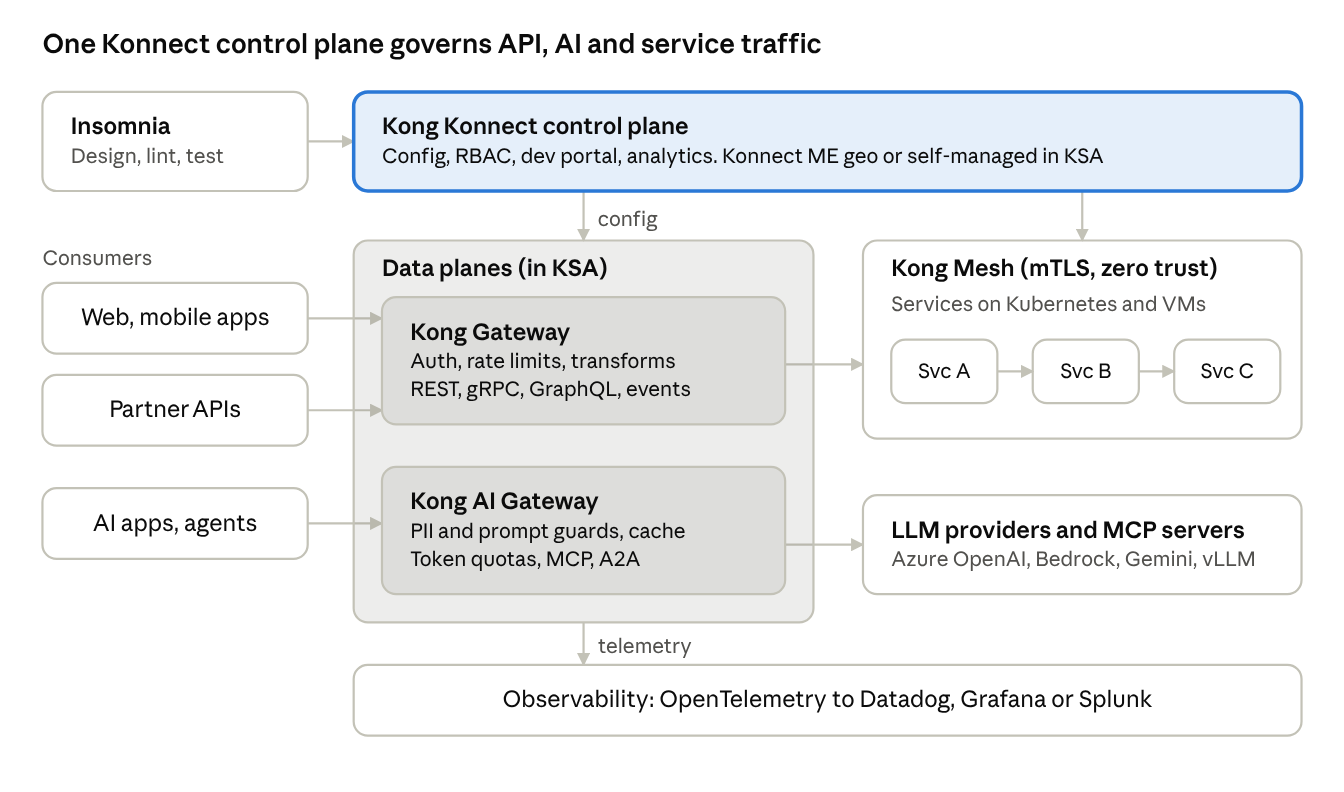
Interkey's standard design separates one control plane from data planes that run where the client's traffic and data must stay.
Apps and partners enter through Kong Gateway, AI apps and agents reach LLMs and MCP servers only through Kong AI Gateway, and services talk to each other over mTLS inside Kong Mesh. Insomnia tests against the live Konnect configuration, and all telemetry flows to the client's observability platform.
In hybrid mode, API traffic and payloads stay on data planes the client runs in KSA; only configuration and telemetry metadata reach the control plane. Where a regulator requires the control plane in-Kingdom too, Interkey deploys self-managed Kong Enterprise and Kong Mesh on the client's infrastructure or a KSA cloud region.
Delivery methodology
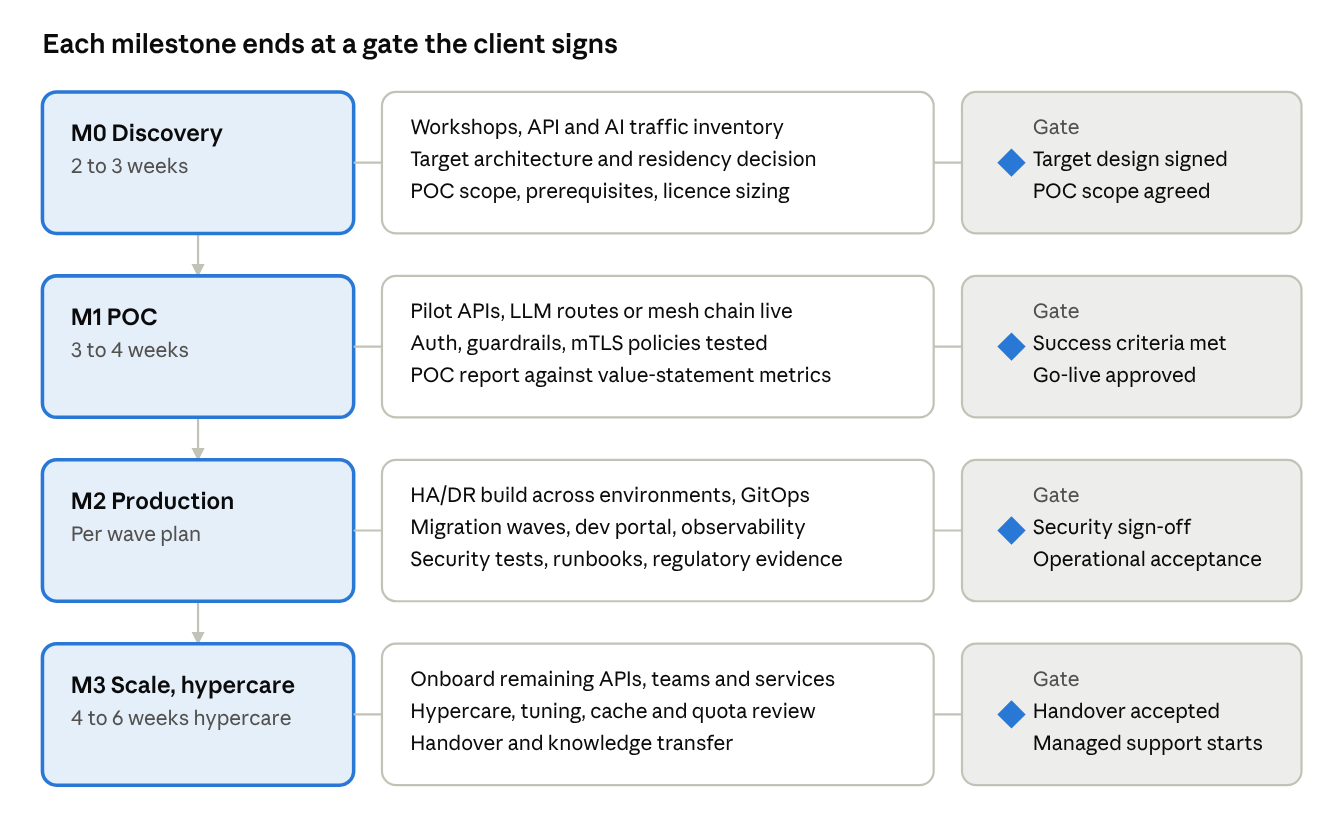
Interkey delivers Kong in four milestones, the same model used for its Datadog engagements. No milestone starts until the previous gate is signed.
- M0 Discovery (2 to 3 weeks): workshops, API and AI traffic inventory, target architecture, residency decision, POC scope and licence sizing.
- M1 POC (3 to 4 weeks): pilot APIs, LLM routes or a mesh chain live, with auth, guardrails and mTLS policies tested against the value-statement metrics.
- M2 Production (per wave plan): HA/DR build across environments with GitOps, migration waves, developer portal, observability, security tests and runbooks.
- M3 Scale and hypercare (4 to 6 weeks): remaining APIs, teams and services onboarded, tuning, cache and quota review, then handover and knowledge transfer.
The POC proves value on a small, representative scope before the client commits to production licensing and rollout.
GCC regulatory alignment
Kong produces much of the technical evidence regulators ask for. Interkey maps each control to a Kong capability during design and leaves the client with the evidence trail.
- Encryption in transit (NCA ECC, SAMA CSF, PCI DSS): TLS at the gateway and automatic mTLS in Kong Mesh.
- Identity and access control: OIDC, OAuth2, mTLS client auth, ACLs, mesh traffic permissions and Konnect RBAC.
- Logging and monitoring: gateway and mesh access logs, audit logs and OpenTelemetry export to the SIEM.
- Personal data protection (PDPL): PII sanitization in AI Gateway and request/response transformation to mask fields.
- Responsible AI (SDAIA AI Ethics Principles): prompt guards, audit of AI calls, token quotas and model allow-lists.
- Open banking (SAMA framework): FAPI-style OAuth2/OIDC, consent-aware routing and a developer portal.
This mapping is technical guidance, not legal advice.
Why Interkey
- Enterprise data and integration depth. Interkey's architects have designed databases, event-driven platforms and integration layers for GCC banks, insurers, retailers and government entities, so Kong is placed in the context of the whole data flow, not just the gateway.
- One delivery method across platforms. The same milestone, POC, prerequisite and value-statement model Interkey uses for Datadog observability.
- Connectivity plus observability. Kong telemetry lands in the same Datadog dashboards Interkey builds for infrastructure, APM and databases.
- Local regulatory context. Designs are mapped to NCA, SAMA and PDPL from day one, with a signed residency decision.
- Knowledge transfer built in. Every milestone ends with runbooks and hands-on sessions, so the client's team can run the platform without Interkey.
A question about this?
Tell us what you are evaluating and we reply with what fits.
More resources
- WhitepaperData platforms Couchbase as the AI Data Plane for Banking and Telecom Why the operational database should become the AI data plane for banks and telecom operators. Covers Couchbase capabilities, a reference architecture, twelve banking and telecom use cases, GCC regulatory alignment and a phased roadmap. Read the whitepaper
- WhitepaperData platforms Architectural Strategies for Resilient, Storage-Aware CDC Pipelines Why Change Data Capture pipelines fail when storage fills up, and how an intelligent control plane prevents it. Covers proactive backpressure, automated storage recovery, adaptive snapshots, idempotent delivery, schema-change protection and a capacity-planning formula. Read the whitepaper
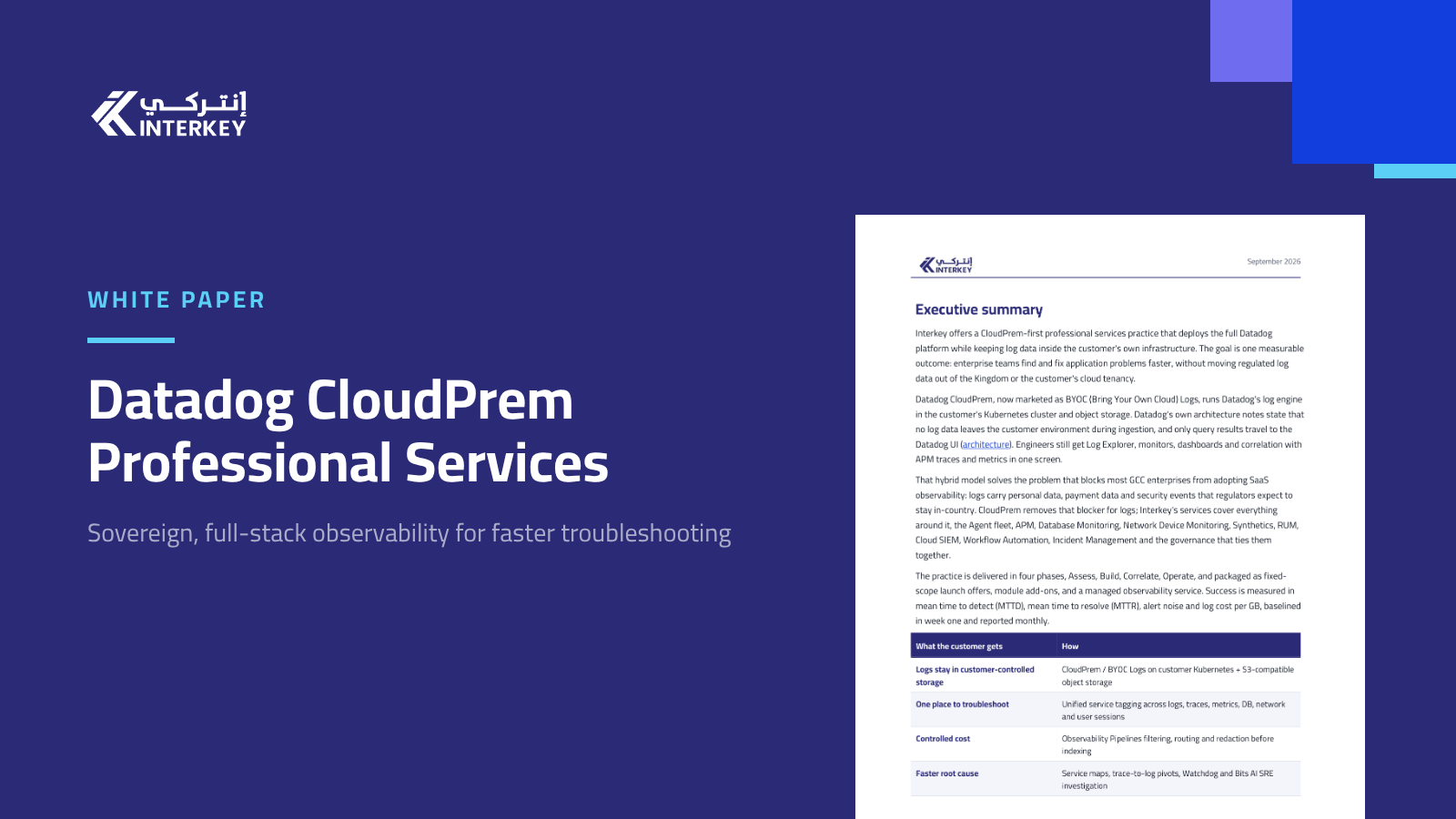
- WhitepaperObservability Datadog CloudPrem Professional Services How Interkey deploys the full Datadog platform with CloudPrem so log data stays inside your own infrastructure. Covers the reference architecture, sizing, HA/DR, a troubleshooting walkthrough, the service catalog, delivery phases and KSA regulatory alignment. Read the whitepaper
Next step
Need something the library does not cover yet?
Tell us what you are evaluating, and an engineer from the Riyadh team replies with what exists, in Arabic or English.
Or directly
+966-11-2180999 [email protected]Tawuniya Towers, North Tower, 7th Floor, King Fahad Highway, Olaya, P.O. Box 56835, Riyadh 11564, Saudi Arabia