Whitepaper · Data platforms
Architectural Strategies for Resilient, Storage-Aware CDC Pipelines
Why Change Data Capture pipelines fail when storage fills up, and how an intelligent control plane prevents it. Covers proactive backpressure, automated storage recovery, adaptive snapshots, idempotent delivery, schema-change protection and a capacity-planning formula.
Published 3 min read
Change Data Capture (CDC) is essential for real-time data integration, yet standard implementations often fail because of unmanaged storage growth. In high-throughput environments, shadow tables in source databases and unconsumed messages in Kafka topics pile up until disks fill and the whole system goes down.
This paper outlines a strategy for building an Intelligent Replication Controller that uses closed-loop feedback to manage storage and keep replication available 99.99% of the time.
Document
Cannot see the document? Open it in a new tab
The problem: the triple-storage burden
Traditional CDC tools work on a push-and-pray model. They do not account for the physical disk limits of the transit layers.
- Source side: CDC sidecar tables or transaction logs grow when the capture process lags.
- Transit side: Kafka brokers store data across multiple replicas, multiplying the storage footprint of every database change.
- Consumer side: if the target (data warehouse or data lake) slows down, Kafka topics swell and create a bottleneck that can crash the brokers.
The solution: an intelligent control plane
A foolproof tool acts as an orchestrator between the source database, Kafka and the destination.
Proactive backpressure. Instead of a linear flow, the tool runs a feedback loop:
- Threshold monitoring: it continuously polls disk I/O, disk space and consumer lag.
- Dynamic throttling: when Kafka disk usage passes a yellow zone (for example 75%), it reduces the ingestion rate; at a red zone (85%), it pauses capture at the source.
Automated storage recovery. The tool does not just monitor; it acts:
- Triggered clean-up: when source storage is critical, it runs forced log truncation or CDC clean-up procedures.
- TTL shifting: it can adjust the Kafka retention.ms property on the fly, shortening retention under heavy load to protect the cluster.
Technical components of the tool
Adaptive initial snapshot. To stop the initial dump from crashing the system, the tool uses watermark-based chunking: it splits each table into logical chunks by primary-key range, checks Kafka's available bytes before starting each chunk, and commits offsets only after the sink acknowledges the chunk.
Metadata and idempotency. For reliable delivery, the tool keeps a central offset store (for example Redis or ZooKeeper) that tracks the high watermark of the source LSN. Every record carries a header with the source timestamp and transaction ID, so the sink ignores duplicates during crash recovery and replay.
Schema evolution shield. The tool intercepts DDL changes. If a column is dropped or a data type changes, it pauses and raises an alert, which stops poison-pill messages from breaking downstream consumers.
A mathematical model for capacity planning
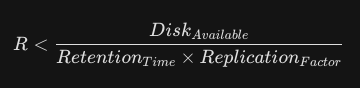
To prevent storage overflow, the tool calculates the safe ingestion rate (R) with the formula above, where:
- Disk_available is the remaining capacity on the Kafka broker.
- Retention_time is the window the sink needs to recover from downtime.
- Replication_factor is the number of copies Kafka keeps of each partition.
Conclusion
A reliable CDC tool is defined not by its speed but by its awareness. With a control plane that monitors storage health and applies backpressure to the source, organisations move from fragile, manual replication to a self-healing data infrastructure.
A question about this?
Tell us what you are evaluating and we reply with what fits.
More resources
- WhitepaperData platforms Couchbase as the AI Data Plane for Banking and Telecom Why the operational database should become the AI data plane for banks and telecom operators. Covers Couchbase capabilities, a reference architecture, twelve banking and telecom use cases, GCC regulatory alignment and a phased roadmap. Read the whitepaper
- WhitepaperSystem integration Interkey Professional Services for Kong How Interkey delivers Kong Gateway, AI Gateway, Kong Mesh and Insomnia as one governed connectivity platform. Covers the reference architecture, service catalog, four-milestone delivery, prerequisites, success metrics and GCC regulatory alignment. Read the whitepaper
- WhitepaperObservability Datadog CloudPrem Professional Services How Interkey deploys the full Datadog platform with CloudPrem so log data stays inside your own infrastructure. Covers the reference architecture, sizing, HA/DR, a troubleshooting walkthrough, the service catalog, delivery phases and KSA regulatory alignment. Read the whitepaper
Next step
Need something the library does not cover yet?
Tell us what you are evaluating, and an engineer from the Riyadh team replies with what exists, in Arabic or English.
Or directly
+966-11-2180999 [email protected]Tawuniya Towers, North Tower, 7th Floor, King Fahad Highway, Olaya, P.O. Box 56835, Riyadh 11564, Saudi Arabia