Whitepaper · Observability
Datadog CloudPrem Professional Services
How Interkey deploys the full Datadog platform with CloudPrem so log data stays inside your own infrastructure. Covers the reference architecture, sizing, HA/DR, a troubleshooting walkthrough, the service catalog, delivery phases and KSA regulatory alignment.
Published 5 min read
Interkey offers a CloudPrem-first professional services practice that deploys the full Datadog platform while keeping log data inside the customer's own infrastructure. The goal is one measurable outcome: enterprise teams find and fix application problems faster, without moving regulated log data out of the Kingdom or the customer's cloud tenancy.
The paper covers the platform and where CloudPrem fits, the reference architecture and engine design, a real troubleshooting walkthrough, the service catalog, the four-phase delivery method, regulatory alignment for KSA and the GCC, and the KPIs every engagement is measured against.
Document
Cannot see the document? Open it in a new tab
Why enterprise troubleshooting is slow today
Most resolution time is spent finding the problem, not fixing it. In a typical GCC enterprise, the evidence for one incident is spread across five or six tools owned by different teams, and nobody can join them quickly.
- Tool sprawl. Infrastructure in one tool, application logs in ELK or Splunk, database stats in vendor consoles, network in an SNMP poller, user complaints in the service desk.
- No shared identity. Logs, traces and metrics use different host names, service names and environment labels, so a trace ID in one tool cannot be pasted into another.
- War-room troubleshooting. Without a service map, teams debate which layer is at fault: network blames the application, the application blames the database.
- Log volume and cost. Self-hosted log clusters grow faster than budgets, so teams cut retention or drop debug logs, exactly the data needed during an incident.
- Data residency blocks SaaS. PDPL, NCA ECC and SAMA expectations make it hard to send security and customer-data logs to an out-of-country SaaS region.
- Alert noise. Static thresholds on hundreds of hosts page people for symptoms, not causes.
Reference architecture
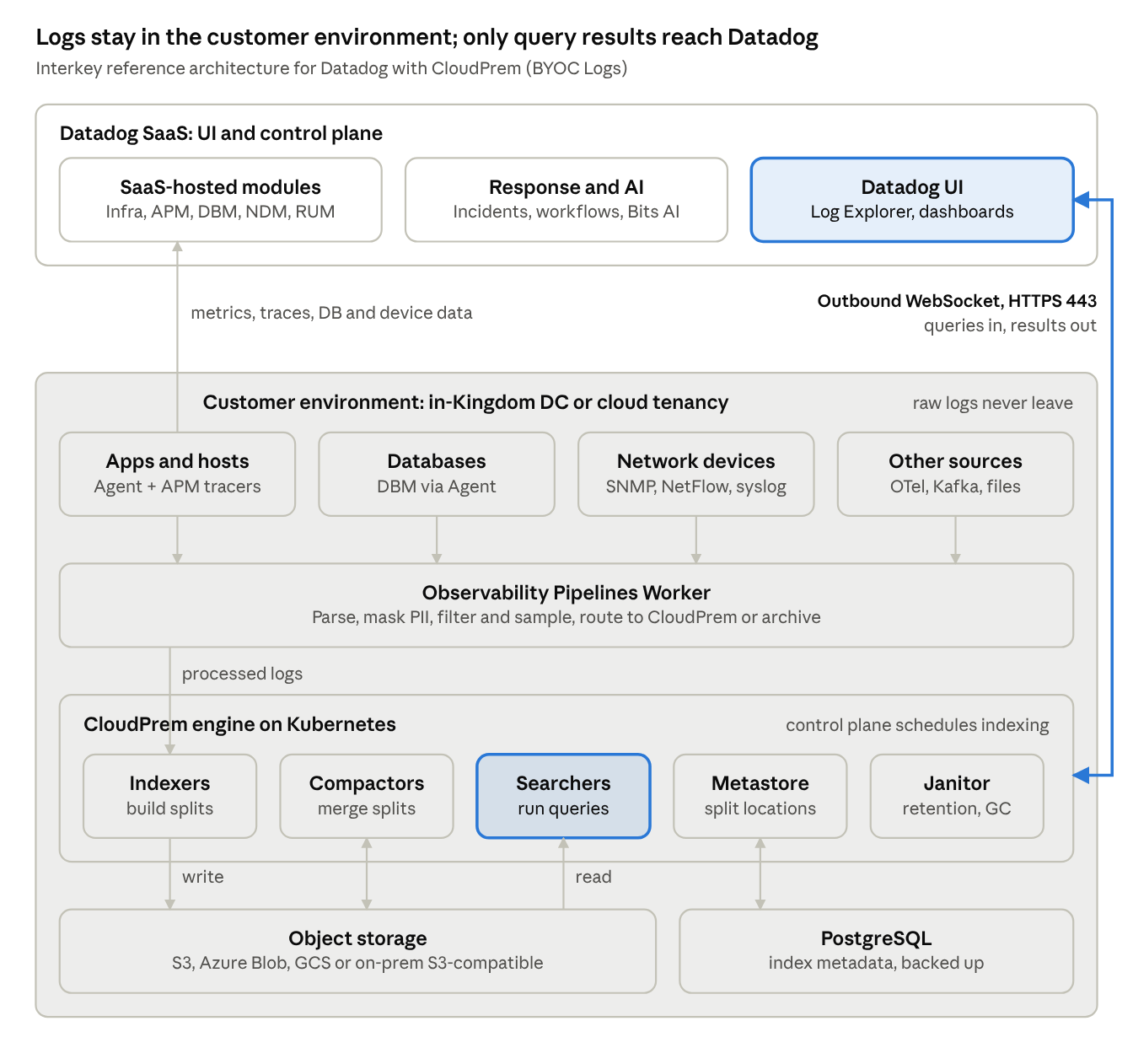
Log data is collected, processed, indexed and stored entirely inside the customer boundary. The only link for logs is an outbound connection that carries queries in and results out.
Agents and APM tracers send metrics, traces, database and device telemetry to Datadog SaaS as usual. Logs take a separate path: Observability Pipelines masks and filters them, CloudPrem indexers write them to the customer's object storage, and searchers answer Datadog UI queries over the reverse connection. Engineers see both in one interface, joined by shared tags.
- No inbound ports: the searchers open an outbound WebSocket over HTTPS 443, through the corporate proxy if required.
- Object storage can be S3, Azure Blob, GCS or on-premises S3-compatible storage such as MinIO, Ceph or NetApp StorageGRID.
- PostgreSQL holds the index metadata, with automated backups and an optional standby replica.
From alert to root cause in one screen
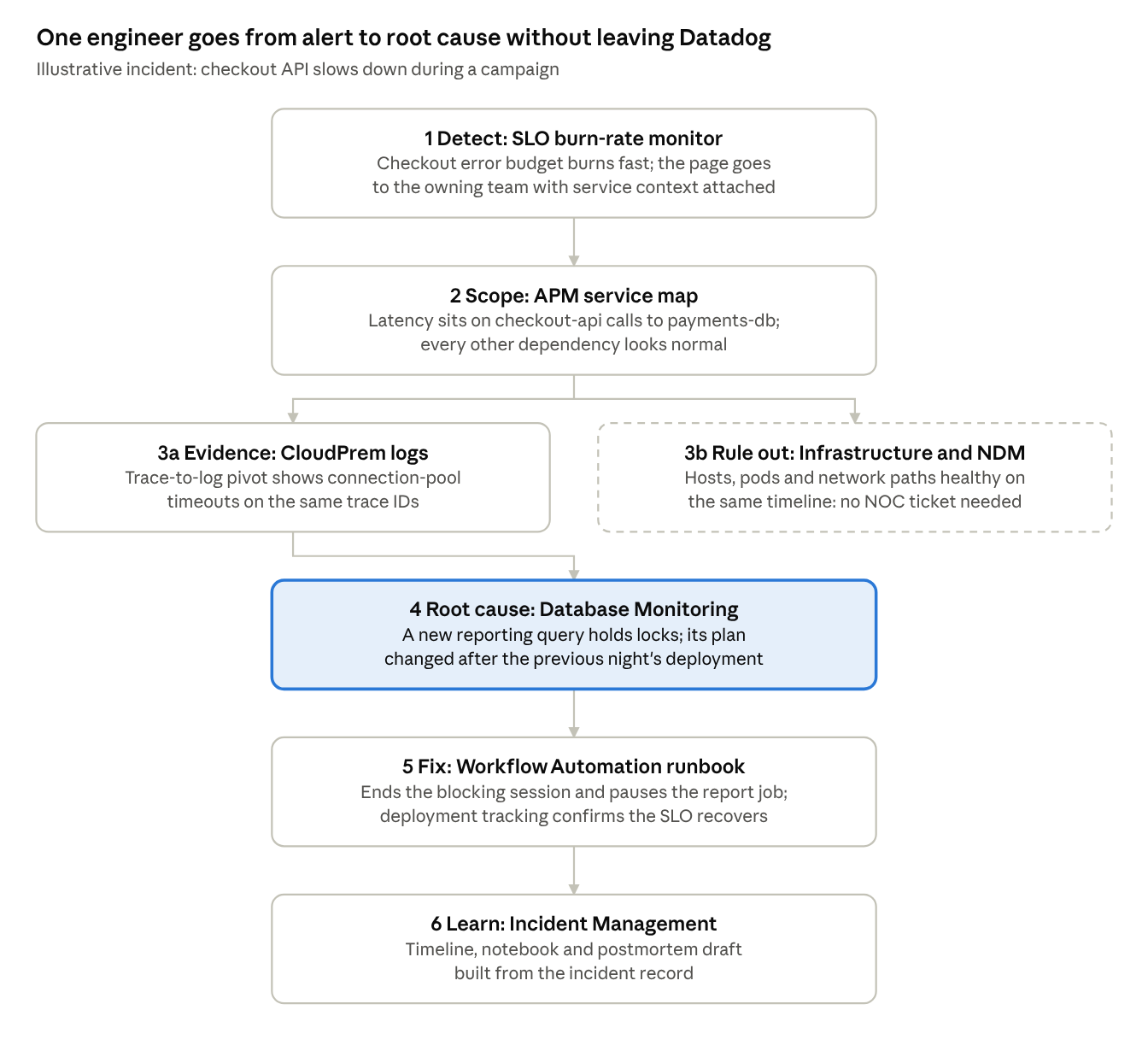
Speed comes from correlation, not from any single module. Every signal carries the same service, environment and version tags, so an engineer moves from alert to root cause in one screen instead of five tools.
In this illustrative incident, a retail customer's checkout API slows down at 20:10 during a campaign. One on-call engineer handles it end to end:
- Detect with an SLO burn-rate monitor that pages the owning team with service context attached.
- Scope with the APM service map: latency sits on calls from checkout-api to payments-db.
- Find the evidence with a trace-to-log pivot into CloudPrem logs, already filtered to the trace.
- Confirm the cause with Database Monitoring: a new reporting query holds locks after last night's deployment.
- Fix and verify with a Workflow Automation runbook, while deployment tracking confirms the SLO recovers.
- Learn from a timeline, notebook and postmortem draft built from the incident record.
Delivery methodology
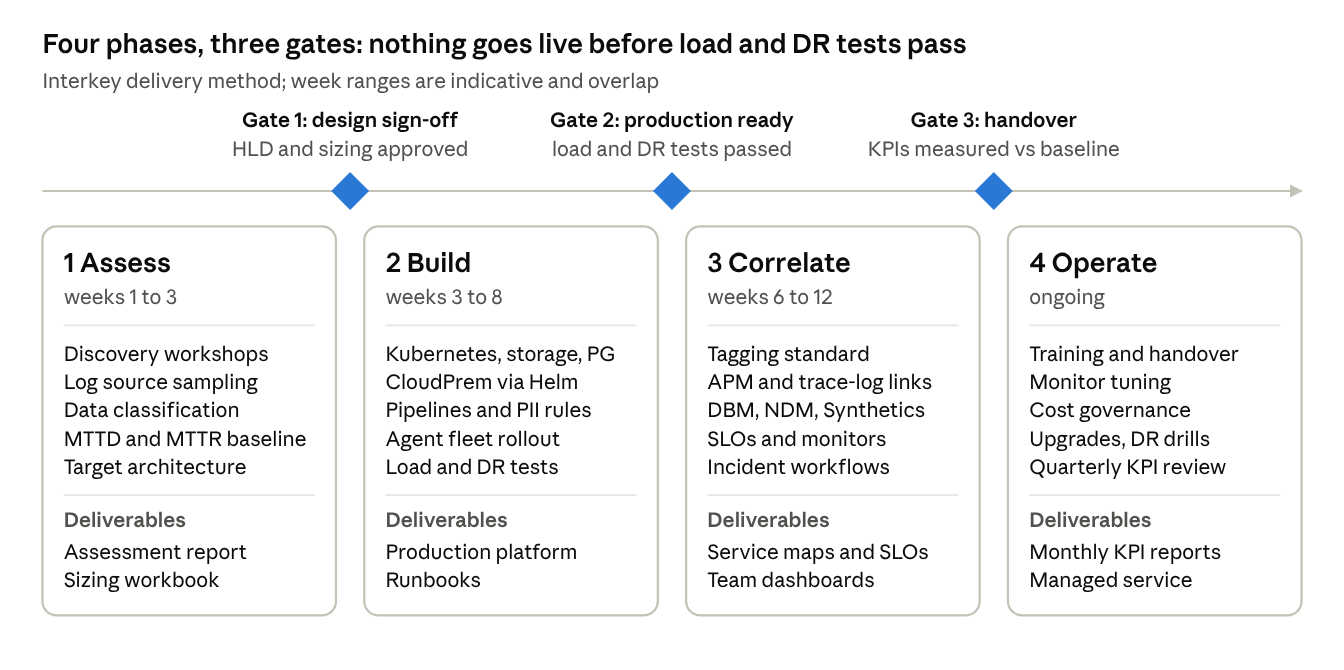
Every engagement follows four phases with a sign-off gate between each, so the customer approves the design before build and the platform proves itself before go-live.
- Assess (weeks 1 to 3): discovery workshops, log-source sampling, data classification, MTTD and MTTR baseline, target architecture.
- Build (weeks 3 to 8): Kubernetes, storage and PostgreSQL, CloudPrem via Helm, pipelines and PII rules, Agent fleet rollout, load and DR tests.
- Correlate (weeks 6 to 12): tagging standard, APM and trace-log links, DBM, NDM, Synthetics, SLOs and incident workflows.
- Operate (ongoing): training and handover, monitor tuning, cost governance, upgrades, DR drills and quarterly KPI reviews.
All configuration, from Helm values to pipelines, monitors and dashboards, is delivered as code (Terraform and Git) so it can be reviewed, versioned and redeployed to a DR site.
Security, governance and regulatory alignment
The design principle is simple: raw log content stays in customer storage, and anything sent to Datadog SaaS is classified and minimised first.
- Data minimisation at the edge. Observability Pipelines masks PII (national ID, IBAN, card numbers, phone numbers) before logs are indexed.
- No inbound exposure. The reverse connection needs only outbound 443 through the corporate proxy.
- Encryption and access control. TLS in transit, encryption at rest with customer-managed keys where supported, SSO/SAML and role-based access.
- Auditability and retention. Datadog Audit Trail records who searched, exported or changed configuration, and per-index retention follows the customer's records schedule.
The design maps to PDPL (SDAIA), NCA ECC and CCC, the SAMA Cyber Security Framework, CST regulations and PCI DSS v4.0. This mapping supports, but does not replace, the customer's own legal and compliance assessment.
Why Interkey
Interkey combines Datadog delivery experience with deep data-platform engineering, which is what a CloudPrem deployment needs: it is as much a Kubernetes, storage and database project as an observability one.
- Datadog field experience in KSA. A retail Datadog rollout covering 75 hosts, 55 APM applications and 20 databases, plus branch-wide Network Device Monitoring with FortiGate autodiscovery and SNMPv3.
- Data-platform depth. Senior architects with 17+ years in databases, event-driven architectures (Kafka) and enterprise software.
- Local regulatory context. Designs start from PDPL, NCA and SAMA requirements rather than retrofitting them.
- Reseller and services in one contract. Licensing, implementation and managed operations under one accountable partner.
A question about this?
Tell us what you are evaluating and we reply with what fits.
More resources
- WhitepaperSystem integration Interkey Professional Services for Kong How Interkey delivers Kong Gateway, AI Gateway, Kong Mesh and Insomnia as one governed connectivity platform. Covers the reference architecture, service catalog, four-milestone delivery, prerequisites, success metrics and GCC regulatory alignment. Read the whitepaper
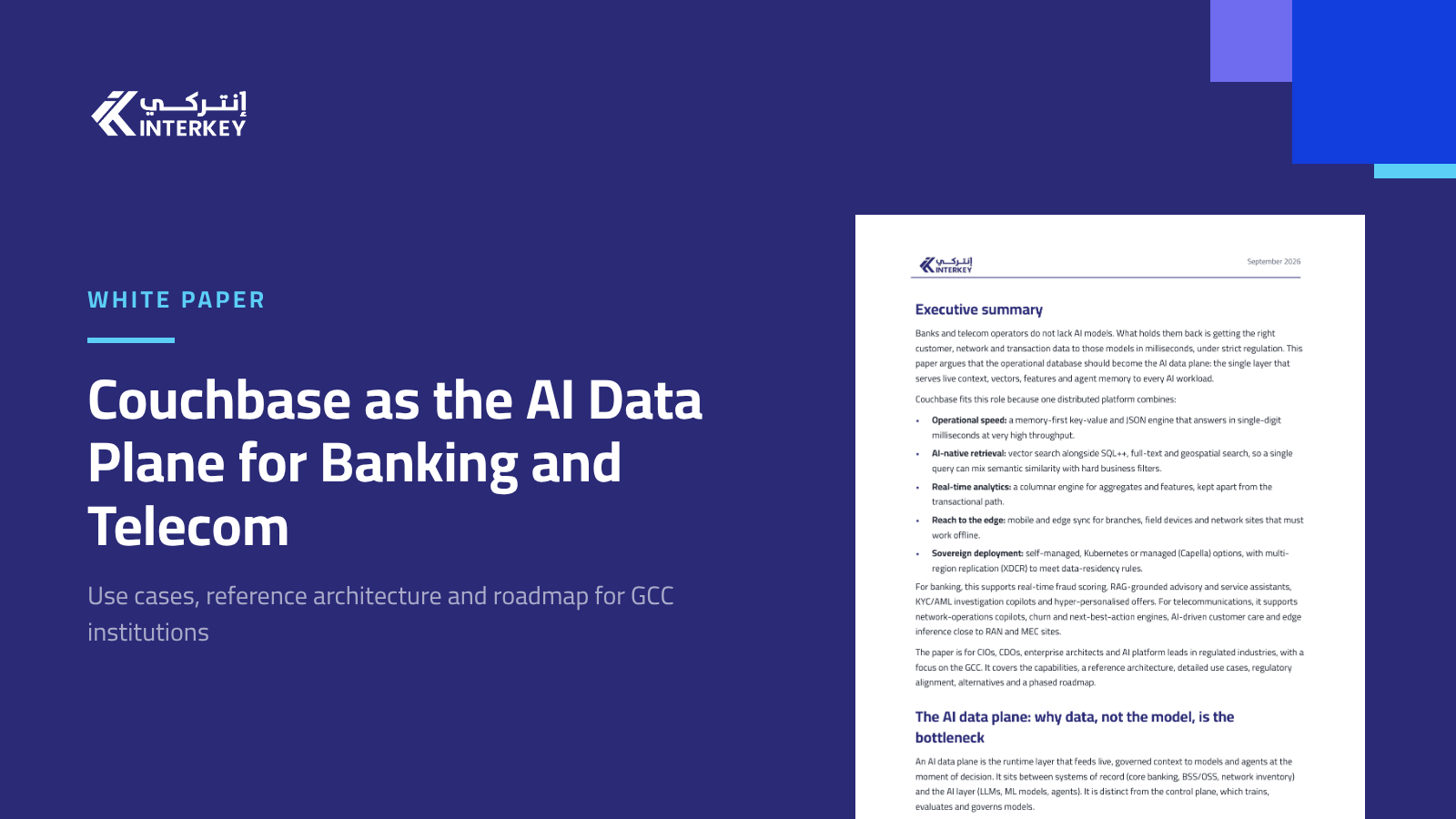
- WhitepaperData platforms Couchbase as the AI Data Plane for Banking and Telecom Why the operational database should become the AI data plane for banks and telecom operators. Covers Couchbase capabilities, a reference architecture, twelve banking and telecom use cases, GCC regulatory alignment and a phased roadmap. Read the whitepaper
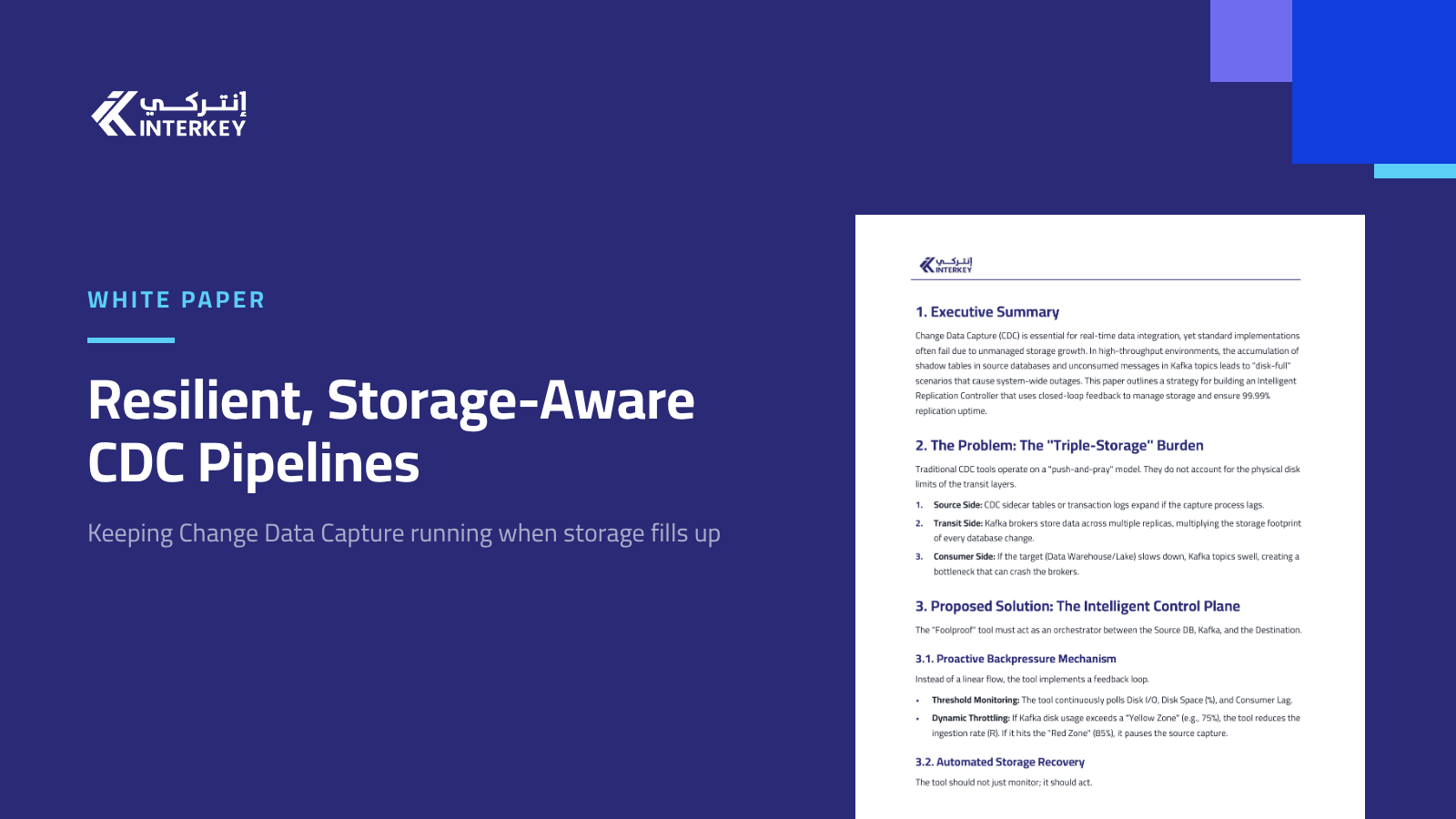
- WhitepaperData platforms Architectural Strategies for Resilient, Storage-Aware CDC Pipelines Why Change Data Capture pipelines fail when storage fills up, and how an intelligent control plane prevents it. Covers proactive backpressure, automated storage recovery, adaptive snapshots, idempotent delivery, schema-change protection and a capacity-planning formula. Read the whitepaper
Next step
Need something the library does not cover yet?
Tell us what you are evaluating, and an engineer from the Riyadh team replies with what exists, in Arabic or English.
Or directly
+966-11-2180999 [email protected]Tawuniya Towers, North Tower, 7th Floor, King Fahad Highway, Olaya, P.O. Box 56835, Riyadh 11564, Saudi Arabia